
By Precious Omatagiren
Sending your song to an engineer you’ve never met can feel uncertain. What do you send? What happens next? How many changes can you ask for? How do you pay?
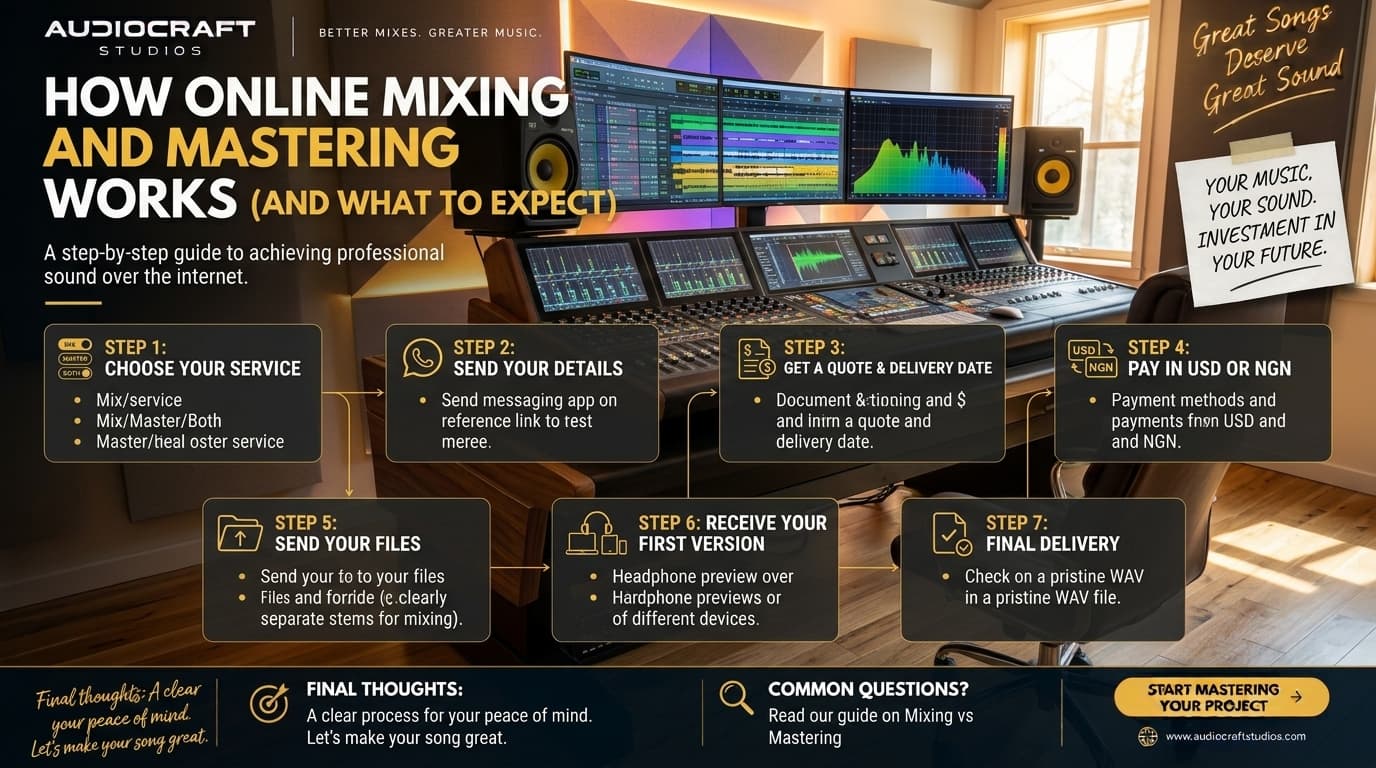
Online mixing and mastering is how most records are finished today, and the process is simpler than it looks. This guide walks you through it from the first message to the final files, so you know what to expect before you commit.
What “online” mixing and mastering means
Online mixing and mastering has made it easier for artists to work with professional engineers from anywhere in the world. And the process is simpler than it looks.
The quality doesn’t depend on where you are. It depends on the quality of your recording, my skill and how clearly you explain what you want.
Step 1: Choose your service
Decide what your song needs.
- Mixing balances and shapes all the parts of your song so they work together.
- Mastering is the final polish on a finished mix, preparing it for release.
- Mixing and mastering together covers both in one go.
If you’re not sure, read my guide on mixing vs mastering, or tell me about your song and I’ll point you in the right direction. You can see what each package includes in my pricing section.
Step 2: Send your details
Start with a short message that tells me about the project. Include:
- Your genre and the feel you’re after.
- How many tracks you have, and whether you need mixing, mastering or both.
- One or two reference songs, so that I can understand the sound you’re aiming for.
- When you want the song back.
You can send all of this through the Start your project form on my site. The more detail you give, the more accurate your quote will be.
Step 3: Get a quote and a delivery date
I’ll read your message, listen to your song if you’ve sent a preview, and reply with a price and a delivery date. This is the moment to ask questions. I’ll explain what is included, how many revisions you get and how long each stage takes.
Nothing starts until you agree to the quote.
Step 4: Pay in USD or NGN
Before making payment, you’ll know exactly what you’re paying for, what’s included in your package and when your project is expected to be completed.
You can pay in US dollars or Nigerian naira. I’ll confirm the amount and how to pay in the quote, so you know the total before any work begins.
Step 5: Send your files
Once the quote and payment are agreed, you send the files.
For mixing, send each individual audio track (often called stem) as its own WAV file, with all files starting from the beginning of the song. Include your rough mix, reference songs and any notes. My guide on how to prepare your session for mixing covers this step by step.
For mastering, send the finished mix as a WAV file with some headroom and no limiter on the master.
Large files are usually shared through a link, such as WeTransfer or Google Drive.
Step 6: Receive your first version
I’ll work on the song and send back the first version. This is usually a preview you can listen to on different speakers, headphones and your phone.
Listen several times before you reply. First impressions help, but listening on a few different systems gives you more useful feedback.
Step 7: Ask for revisions
Your revision allowance and the scope of changes covered will be explained before work begins. Each package lists how many revisions are included.
Good revision notes are specific:
- “Bring the vocal up a little in the second verse.”
- “The bass feels too heavy on my phone.”
- “Can the backing vocals be wider in the chorus?”
Vague notes such as “make it better” are hard to act on. Revisions are for adjusting the sound, not for rewriting the song, changing the arrangement or replacing parts, which usually count as new work.
Step 8: Final delivery
When you’re happy, I’ll send the final files. This is normally a full-quality WAV file, and often an MP3 for sharing. Check the files before you release the song. Play them from start to finish and make sure nothing is missing or cut off.
How long does it take?
It depends on the service, the number of tracks and how quickly you reply during revisions. Each package shows its turnaround time, and your quote will confirm the delivery date for your song. A clean, well-prepared session and clear feedback are the best ways to keep things moving.
Questions people ask before they start
- Is online mixing as good as working in person? Yes. Online mixing can achieve the same professional standard as working with an engineer in person. The quality depends on the recording, the engineer’s skills, monitoring environment and communication throughout the process, not simply on being in the same room.
- Do I have to send stems? For mixing, yes, because each part needs to be balanced separately. For mastering, you send one stereo mix.
- What if I’m not happy with the result? Use your revisions. Give clear notes about what you want changed, and I’ll adjust the mix or master.
- Can I send a song for mastering only? Yes, if the mix is already finished and balanced. If the mix has problems, I’ll tell you honestly that it needs a remix first.
- How do I get the best result? Send clean files, include references and notes, and give clear feedback.
Final thoughts
Online mixing and mastering is a clear process: choose your service, send your details, agree the quote, send your files, review the first version, request revisions and receive your final files. Once you know the steps, there’s nothing to worry about.
If you’d like to know what it costs, read my guide on how much mixing and mastering costs.
When you’re ready, send me your song, your genre and a reference track, and I’ll reply with a clear quote and a delivery date.
Leave a Reply